
SaaS & Startups, Web application
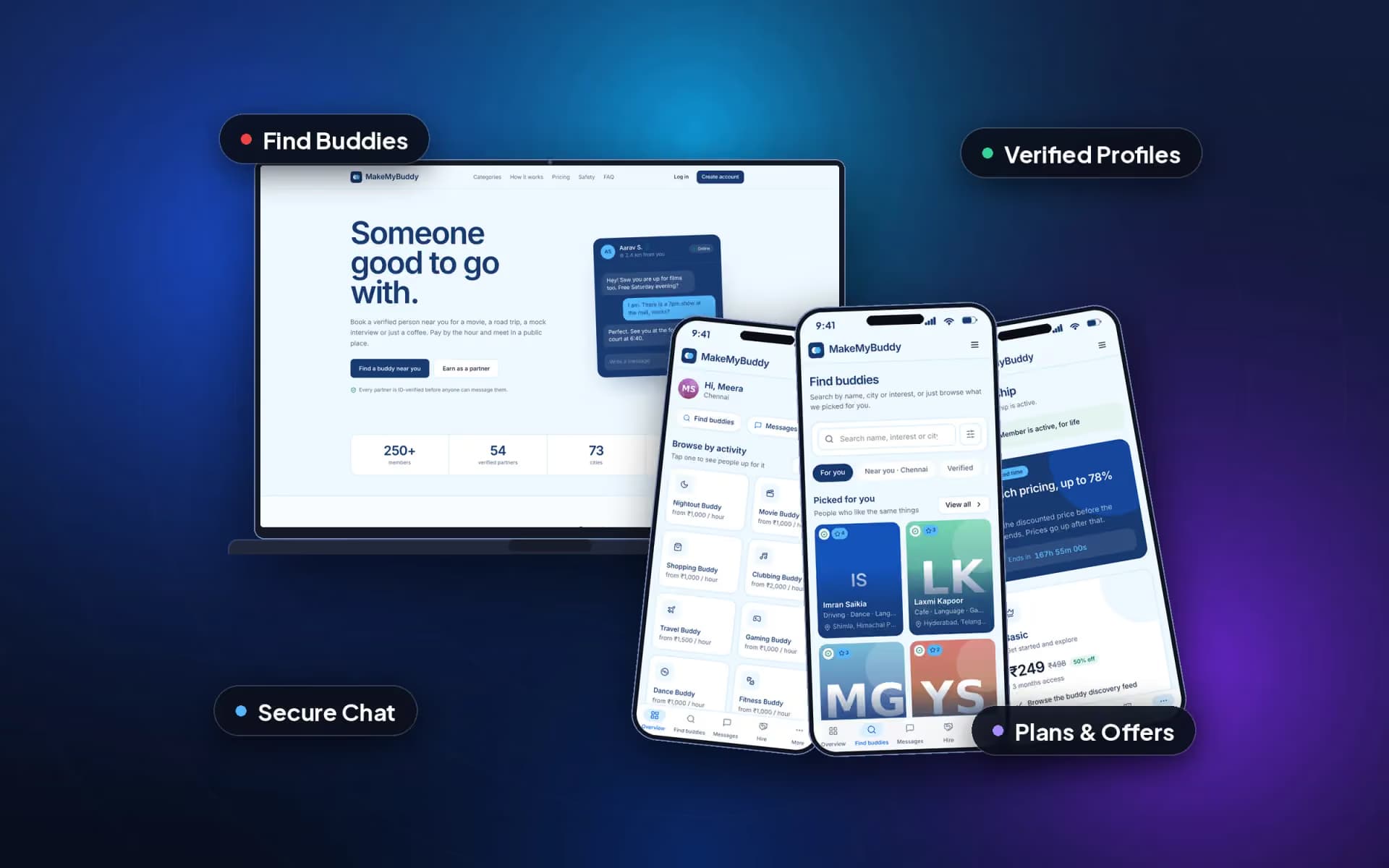
MakeMyBuddy lets people book a verified companion nearby for a movie, a trip, the gym, a mock interview or just a coffee. Pen Programmer designed and built the whole product: the public website, the user panel, the admin panel.
- Client
- Joy Barman
- Industry
- SaaS & Startups
- Type
- Web application
- Year
- 2026
- Platforms
- Web
Background
Plenty of people have something they want to do and nobody free to do it with. A film on a weekday, a trek, a first gym session, a practice interview before the real one.
MakeMyBuddy wanted to turn that into a safe, simple booking platform: find someone nearby who is up for the same thing, see that they are a real verified person, message them, and meet in a public place. Pen Programmer came in as the technology partner and built the product end to end.
The problem
A platform where strangers meet carries risks a shopping app never faces. The product had to earn trust before it could earn a booking.
- Safety: users needed to know the person on the other side is real and ID-checked.
- Privacy: conversations, phone numbers and ID documents all had to stay private.
- Clarity: the platform is platonic and public-place only, and had to say so everywhere.
- Economics: the business runs on memberships, so plans, offers and upgrades had to work exactly right.
"People will not meet a stranger because an app says it is safe. They do it when the app can show why."
Objectives & constraints
Objectives
- A verified-only discovery feed, so unverified accounts cannot reach anyone.
- Private messaging between members, with reporting and moderation built in.
- Memberships with plans, offers, coupons and mid-cycle upgrades.
- An admin panel controlling categories, cities, plans, content, branding and moderation.
Constraints
- A standard PHP and MySQL VPS, not a cloud-native stack with managed services.
- Every API payload encrypted, with no request ever replayable.
- Most users on phones with patchy mobile data.
- A small team, so the admin panel had to replace developer work, not create it.
Research & strategy
We looked at what makes people hesitate before meeting someone new. It was rarely the price. It was who is this person, and what happens if it goes wrong.
Our strategy:
- Verification first. Build the ID check and the moderation tools before the social features.
- Encrypt by default. Design the API so an unencrypted request is impossible, not optional.
- Keep the stack boring. PHP, MySQL and a VPS, so the client's team can run it without specialists.
- Make the admin panel the product. Anything the business might change should be a setting, not a deploy.
Design approach
One rule guided every screen: the next safe step should always be obvious.
- Discovery that reassures: every profile card carries its verification state.
- Honest empty states: an unverified user is told plainly what they cannot do yet, and how to fix it.
- App-like on a phone: bottom navigation, full-screen chat, installable to the home screen.
- Plans you can compare: prices, offers and what each plan unlocks, side by side.
- One admin language: every panel screen uses the same tables, drawers and confirmations.
Key features and journeys
Verified discovery
Browse people by activity, city and interest — verified profiles only
ID verification
Aadhaar-based KYC with admin review, approval and rejection notes
Private chat
Member-to-member messaging with read state and push alerts
Hire board
Post what you need, or offer yourself, and receive counter offers
Memberships
Plans, limited-time offers, coupons and pro-rata upgrades
Profile badges
Plan-based badges and featured placement in Top Buddies
Reports & moderation
Users report a conversation; admins review, warn or ban
Admin panel
Categories, cities, plans, pages, broadcasts, branding and reports
Technical architecture
- Frontend: Next.js App Router — the marketing site, the user panel and the admin panel in one build.
- Backend: PHP APIs that decrypt, verify, act and encrypt the reply.
- Database: MySQL, with migrations that can be re-run safely on any environment.
- Realtime: an optional Socket.IO relay that carries only a wake-up signal, with a background check as fallback.
- Delivery: installable PWA with its own service worker, offline page and web push.
- Next.js
- MySQL
- RSA-4096 OAEP
- NodeJS
- Socket.IO
- Progressive Web App
Challenges & decisions
1. Encrypting every request, without a database for replay protection
The brief was strict: every payload and every response encrypted, and no request ever repeatable — without using the database to track what had already been seen.
Decision: each request carries a one-time nonce and a timestamp inside an RSA-4096 + AES-256-GCM envelope. The nonce is burned in shared memory, falling back to atomic file creation, both of which fail if the nonce already exists. A replayed request is rejected before it reaches any business logic, and the database is never touched to decide it.
2. Real-time chat on a PHP stack
Chat needs to feel instant. PHP request-per-connection does not, and long polling started starving the server as soon as two tabs were open.
Decision: we added a small Socket.IO relay that carries only a wake-up signal — never message content. When it fires, the app fetches the actual messages through the same encrypted gateway as everything else. The relay is optional: an admin can switch it off and the app falls back to a light background check. Chat got fast without putting a second, weaker path to the data.
3. Uploads that cannot carry anything hidden
Profile photos and ID documents are uploaded by strangers. A MIME-type check stops nothing.
Decision: every upload is checked by magic bytes, confirmed as a real image by the decoder, size- and dimension-limited, then re-drawn pixel by pixel and re-encoded by the server. Only decoded pixels survive, so a file carrying a payload loses it. Files are stored outside the web root with random names, and served only to people entitled to see them.
4. Keeping ID data private while still being able to use it
KYC only helps if the data behind it is handled properly.
Decision: the ID number is validated by checksum, stored encrypted at rest, and shown masked everywhere except the single admin review screen, where revealing it is a deliberate action. A hash stops the same ID being used by two accounts without storing the number in a searchable form.
5. Making silent failures visible
Web push can fail in a way that looks like success: the browser says notifications are allowed while no subscriber was ever created, so nothing sends and nothing errors.
Decision: we separated permission from subscription in the code, and added a diagnostics panel in admin settings that reports what this browser actually has — permission state, subscriber id, what the service worker URL really returned, and when the live build was made. Problems that used to take a day of guessing now read as one line on screen.
Results
- A platform where only ID-verified profiles appear in discovery, enforced on the server.
- Every API request encrypted and single-use, with replay protection that needs no database.
- Chat, Hire offers, verification updates and admin broadcasts all delivered as push notifications.
- A PWA that installs to the home screen and still opens with no connection.
- An admin panel that owns plans, offers, coupons, categories, cities, pages, branding and moderation — no deploy needed to change any of them.
- Migrations that replay safely, verified to produce a schema identical to a fresh install.
Lessons learned
- Safety is a feature people can see. A verification badge does more for conversion than any amount of copy.
- Encrypt at the edge of the design, not the end. Building the envelope first made every later feature inherit it for free.
- A wake-up signal is not data. Keeping the realtime channel thin meant speed cost us nothing in security.
- Give failures a voice. The bugs that cost the most were the quiet ones, not the loud ones.
- An admin panel is cheaper than a deploy. Every setting we exposed is a support request that never reaches a developer.
"Trust is not a screen in the product. It is the order you build things in."
Services involved
Next case study
BillHub
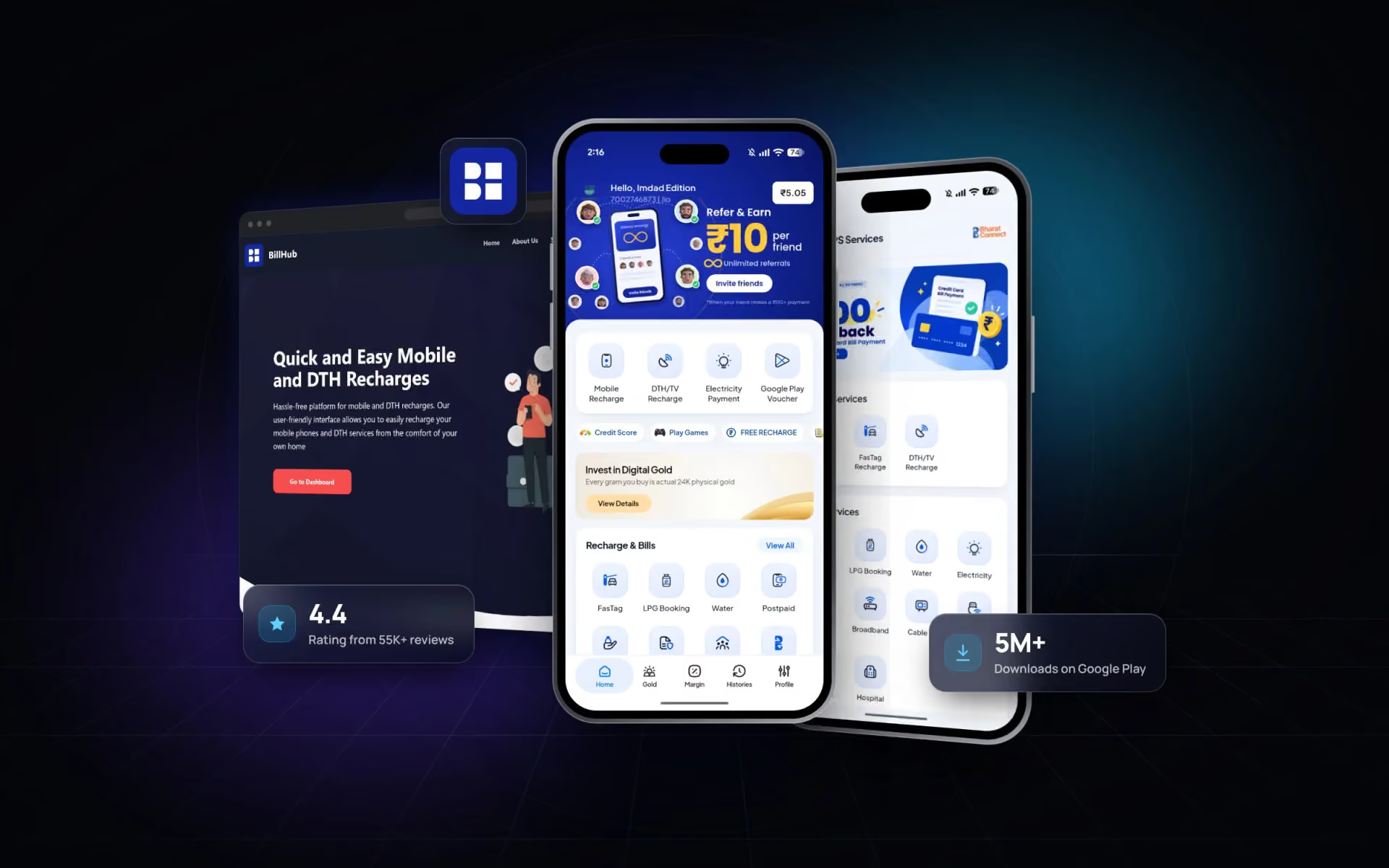
BillHub is a recharge and BBPS bill payment app built end to end by Pen Programmer, with 5M+ downloads and a 4.4★ rating on Google Play. We designed and built the web app, Android and iOS apps, the backend and the admin panel.
Have a project like this?
Tell us what you're building. We'll get back to you with next steps.
